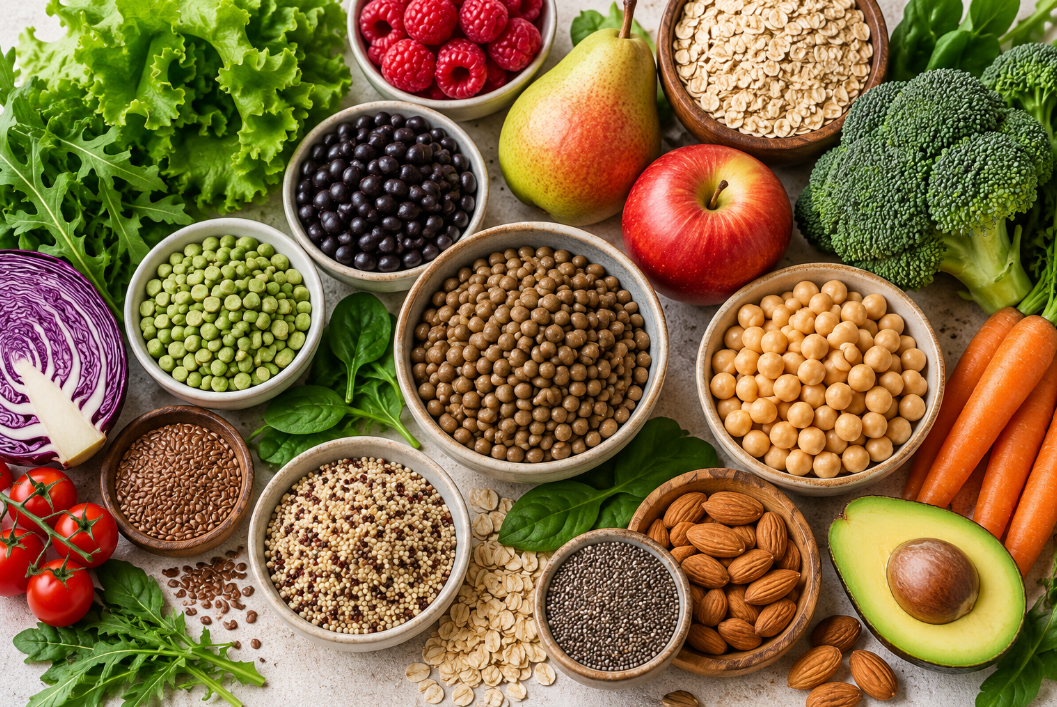
Dietary fiber is an important component of a balanced diet. Unlike protein, fat, and most carbohydrates, however, it is not fully digested by the human body.
Fiber is found mainly in plant-based foods such as legumes, fruits, vegetables, whole grains, nuts, and seeds.
Adequate fiber intake is important for more than just normal bowel function. Higher dietary fiber intake has been associated with better cardiometabolic health and a lower risk of several chronic diseases. 1, 2, 3, 4
What is dietary fiber?
Dietary fiber refers to a diverse group of carbohydrates that are not fully broken down by human digestive enzymes in the small intestine.
Fiber is often classified as soluble or insoluble, although in practice there are many different types of fiber with different physicochemical properties.
Some types of fiber absorb water and form a viscous material in the intestine, while others help increase stool bulk. Many dietary fibers can also be fermented by microorganisms in the gut, producing metabolites including short-chain fatty acids. 4
For this reason, total fiber intake is not the only consideration. A diet that includes a variety of plant foods provides different types of fiber as well as other important nutrients.
Why is dietary fiber important?
It supports normal bowel function
Dietary fiber increases stool bulk and, depending on the type of fiber, can help retain water and support normal bowel function.
EFSA has used normal bowel function as a key criterion for establishing an adequate daily intake of dietary fiber. 2
It affects the gut microbiome
Many dietary fibers are fermented by gut bacteria and can influence the activity and metabolism of the gut microbiome. 4
This does not mean that there is one particular type of fiber or one specific food that creates a “perfect” gut microbiome. Responses vary considerably between individuals, and this field of research is still evolving. 4
It is associated with better cardiometabolic health
A major series of systematic reviews and meta-analyses published in The Lancet included data from 185 prospective studies and 58 clinical trials. 3
Higher dietary fiber intake was associated with a lower risk of coronary heart disease, stroke, type 2 diabetes, colorectal cancer, and all-cause mortality. In clinical trials, higher intake was also associated with modest improvements in measures such as blood pressure and total cholesterol. 3
Because much of the evidence on long-term health outcomes comes from observational studies, these associations should not be interpreted as proof that dietary fiber alone prevents a specific disease.
How much dietary fiber do we need per day?
The World Health Organization (WHO) recommends that adults consume at least 25 grams of naturally occurring dietary fiber per day, primarily from foods such as:
- whole grains
- vegetables
- fruits
- legumes. 1
For children, WHO recommends lower amounts depending on age: at least 15 g/day for children aged 2–5 years, 21 g/day for those aged 6–9 years, and 25 g/day from the age of 10 years. 1
Similarly, the European Food Safety Authority (EFSA) considers an intake of 25 g of dietary fiber per day adequate for normal bowel function in adults. EFSA also notes that intakes above 25 g/day, as part of a diet rich in fiber-containing foods, have been associated with additional health benefits. 2
In the large analysis published in The Lancet, an intake range of 25–29 g/day was associated with important benefits across several health outcomes, with evidence suggesting that higher intakes could provide additional benefits. 3
15 foods high in fiber
The amounts below are based on USDA data and refer to specific serving sizes. 5 Actual fiber content can vary depending on the variety, processing, cooking method, and specific product.
| Food | Approximate serving | Dietary fiber |
|---|---|---|
| Split peas, cooked | 1 cup | 16 g |
| Lentils, cooked | 1 cup | 15.5 g |
| Black beans, cooked | 1 cup | 15 g |
| White beans, canned | 1 cup | ≈13 g |
| Chia seeds | 28 g | 10 g |
| Green peas, boiled | 1 cup | 9 g |
| Raspberries | 1 cup | 8 g |
| Whole-wheat pasta, cooked | 1 cup | 6 g |
| Barley, cooked | 1 cup | 6 g |
| Pear | 1 medium | 5.5 g |
| Broccoli, cooked | 1 cup | 5 g |
| Quinoa, cooked | 1 cup | 5 g |
| Apple with skin | 1 medium | 4.5 g |
| Oatmeal, cooked | 1 cup | 4 g |
| Almonds | 28 g, about 23 almonds | 3.5 g |
Legumes stand out
One thing that becomes immediately clear from the table is that legumes are particularly rich in dietary fiber.
One cup of cooked lentils, for example, provides approximately 15.5 g of fiber, which is more than half of the minimum daily target of 25 g. 5
At the same time, legumes provide plant protein and a range of micronutrients, making them a particularly useful component of a balanced dietary pattern.
How can you reach 25 g of fiber in one day?
You do not need to rely on a single food that is exceptionally high in fiber.
For example:
- 1 medium pear → 5.5 g
- 1 cup cooked oatmeal → 4 g
- ½ cup cooked lentils → approximately 7.8 g
- 1 cup cooked broccoli → 5 g
- 28 g almonds → 3.5 g
Total: approximately 25.8 g of dietary fiber.
And this is only one example. Fruits, vegetables, legumes, nuts, seeds, and whole-grain foods can be combined in many different ways.
More fiber does not mean you should increase your intake suddenly
For someone who currently consumes very little dietary fiber, increasing intake too quickly may cause:
- bloating
- gas
- abdominal discomfort
- changes in bowel movements.
For this reason, it is generally preferable to increase fiber intake gradually while also maintaining adequate fluid intake. 5
There are also certain diseases or medical situations in which a lower-fiber diet may temporarily be recommended. General recommendations therefore do not replace individualized advice from a healthcare professional.
Conclusion
Dietary fiber is not found only in a special food or supplement. It occurs naturally in a wide range of plant-based foods that can easily be incorporated into the daily diet.
WHO recommends at least 25 g of naturally occurring dietary fiber per day for adults, while EFSA considers the same amount adequate for normal bowel function. 1, 2
Legumes, whole grains, fruits, vegetables, nuts, and seeds can all help meet this amount when consumed as part of a varied diet, without the need to rely on a single food.
Sources
[1] World Health Organization. Carbohydrate intake for adults and children: WHO guideline. 2023.
WHO – Carbohydrate Intake for Adults and Children
[2] European Food Safety Authority (EFSA). Dietary Reference Values for nutrients: Summary report. EFSA considers an intake of 25 g/day adequate for normal bowel function in adults.
EFSA – Dietary Reference Values for Nutrients
[3] Reynolds A, Mann J, Cummings J, et al. Carbohydrate quality and human health: a series of systematic reviews and meta-analyses. The Lancet. 2019;393:434–445.
PubMed – Reynolds et al.
[4] Delzenne NM, Bindels LB, Neyrinck AM, et al. The gut microbiome and dietary fibres: implications in obesity, cardiometabolic diseases and cancer. Nature Reviews Microbiology. 2025;23:225–238.
Nature Reviews Microbiology – Dietary Fiber and the Gut Microbiome
[5] Mayo Clinic. Chart of high-fiber foods. Nutrient values based on USDA food composition data.
Mayo Clinic – High-Fiber Foods
Comments
💬 Join the discussion