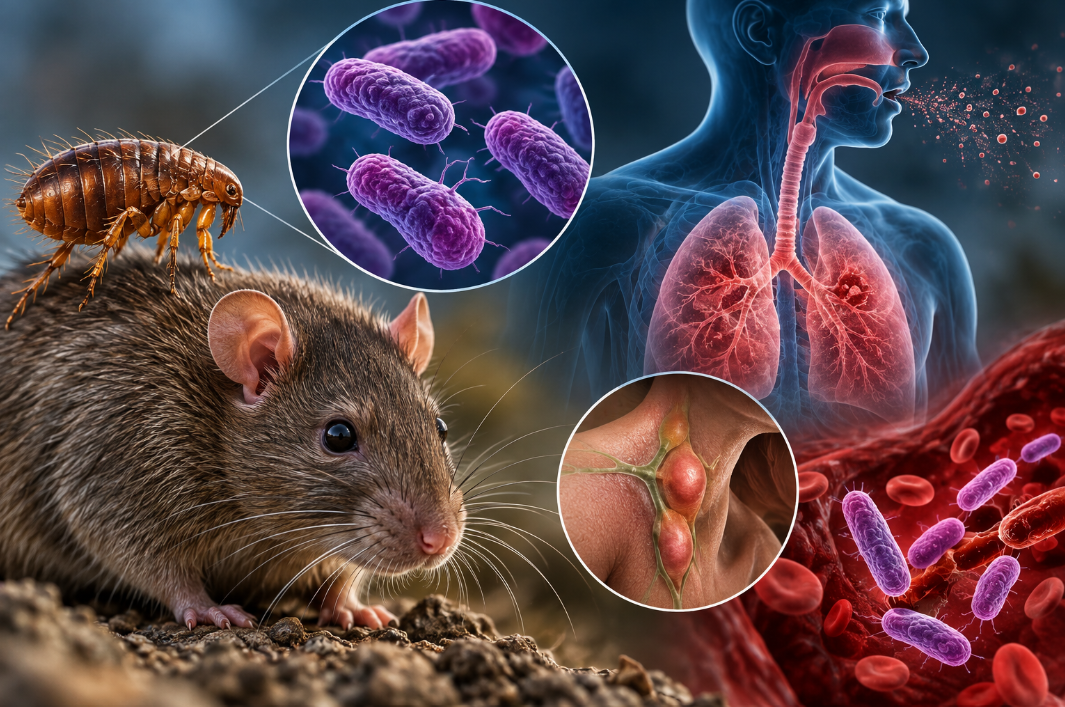
What Is Plague?
Plague is a zoonotic disease, meaning an infection that is maintained in animal populations and can be transmitted to humans. It is caused by the Gram-negative bacterium Yersinia pestis.
Plague is most commonly transmitted through flea bites. Although major plague epidemics have occurred throughout history, the disease still exists today, although it is now very rare. Globally, approximately 1,000 to 2,000 people are diagnosed with plague each year. [1, 2, 4]
The bacterium is very closely related to Yersinia pseudotuberculosis. Genetic research has shown that Y. pestis evolved from an ancestral bacterium thousands of years ago, gradually acquiring genetic characteristics that contributed to its adaptation to flea-borne transmission and its ability to cause systemic disease. [4, 8]
Ancient DNA evidence indicates that strains of Y. pestis were already infecting humans approximately 5,000 years ago, although the earliest strains did not possess all the characteristics associated with the later emergence of bubonic plague. [8]
The association between Y. pestis and the Black Death is not merely a historical hypothesis. DNA analysis of human remains from 14th-century plague victims has confirmed that the bacterium was responsible for the pandemic. [9]
What Are the Different Types of Plague?
The type of plague depends on the part of the body in which the Y. pestis infection becomes established. [1, 2, 3]
Bubonic Plague
Bubonic plague is the most common form of the disease and is also associated with the highest survival rates.
After the bacterium enters the body, most commonly through the bite of an infected flea, Y. pestis can travel through the lymphatic system to a nearby lymph node. There, it multiplies and causes severe inflammation. [2]
A characteristic feature of this form of plague is the development of buboes. These are enlarged and painful lymph nodes that commonly appear in the groin, armpits, or neck. [3]
If the infection is left untreated, the bacterium can spread into the bloodstream or the lungs. [1, 3]
Septicemic Plague
Septicemic plague occurs when Y. pestis multiplies in the bloodstream.
It can develop as a primary infection, for example following the bite of an infected flea, or as a complication of bubonic plague. This form of the disease can lead to severe sepsis, blood-clotting abnormalities, tissue damage, hemorrhagic manifestations, and multiple organ failure. [2, 3]
Pneumonic Plague
Pneumonic plague is an infection of the lungs and is one of the most severe forms of the disease.
It can occur secondarily when the bacterium spreads to the lungs from another part of the body, or it can develop as primary pneumonic plague following the inhalation of infected respiratory droplets. [2, 3]
Pneumonic plague is particularly important from a public health perspective because it can be transmitted from person to person. The disease can progress very rapidly and, without prompt treatment, mortality is extremely high. [1, 3]
Pharyngeal Plague
Pharyngeal plague is an infection of the pharynx caused by Y. pestis. It is a rare form of the disease that may occur following the consumption of contaminated meat. [2]
What Are the Symptoms of Plague?
The incubation period is usually between one and seven days, depending on the form of the disease and the route of exposure. [1]
Initial symptoms may include:
- Fever, often with sudden onset
- Chills
- Severe weakness
- Headache
- Muscle aches
- Nausea or vomiting [1, 3]
Symptoms can also differ depending on the form of the disease:
- Bubonic plague: enlarged and painful lymph nodes.
- Septicemic plague: tissue damage, multiple organ failure, low blood pressure, and severe systemic infection.
- Pneumonic plague: cough, shortness of breath, chest pain, sputum production, and, in some cases, coughing up blood. Primary pneumonic plague usually has a shorter incubation period and can worsen rapidly.
How Is Plague Transmitted?
Plague is most commonly transmitted through the bite of a flea that has previously become infected after feeding on rats or other animals carrying Y. pestis. [2, 4]
This route of exposure is primarily associated with bubonic plague.
Contact With Infected Animals
Transmission can also occur through contact with infected animal tissues or bodily fluids, particularly when there is a break in the skin. [1, 3]
Person-to-Person Transmission
Plague can be transmitted from person to person, but this does not occur with all forms of the disease.
The main form capable of direct human-to-human transmission is pneumonic plague. Transmission occurs through respiratory droplets, which can infect people who are in close contact with an infected person. [1, 10]
Consumption of Contaminated Meat
Pharyngeal plague may occur following the consumption of raw or inadequately cooked meat from an infected animal. [2]
How Is Plague Diagnosed?
Diagnosis is based on a combination of:
- Clinical symptoms
- A history of possible exposure
- Laboratory confirmation [3]
The type of clinical specimen collected depends on the form of the disease. Samples may include blood, sputum, or fluid aspirated from an affected lymph node, among others. [2, 3]
Culture and isolation of the bacterium remain a key component of laboratory diagnosis, while molecular and immunological methods can also be used to detect the pathogen or specific antigens. [2, 3]
Prompt laboratory investigation is important. However, when there is a strong clinical suspicion of plague, treatment should not be delayed while waiting for definitive laboratory confirmation. [5, 6]
How Is Plague Treated?
Although plague is a serious bacterial infection, effective antimicrobial treatment is available.
The choice of treatment depends on the form and severity of the disease, as well as the patient’s age, pregnancy status, potential contraindications, and other clinical characteristics. [5, 6]
Treatment should begin as early as possible when there is a strong suspicion of plague. [6]
How Can Plague Be Prevented?
In areas where Y. pestis circulates naturally, prevention focuses on reducing exposure to infected fleas and animals.
Preventive measures include:
- avoiding unprotected handling of sick or dead wild animals,
- implementing flea-control measures,
- protecting pets from fleas in endemic areas,
- using appropriate personal protective equipment during occupational exposure,
- rapidly identifying and isolating suspected cases of pneumonic plague,
- tracing and assessing close contacts. [1, 7]
In certain cases involving significant exposure, post-exposure antibiotic prophylaxis may be recommended following assessment by public health authorities. [6]