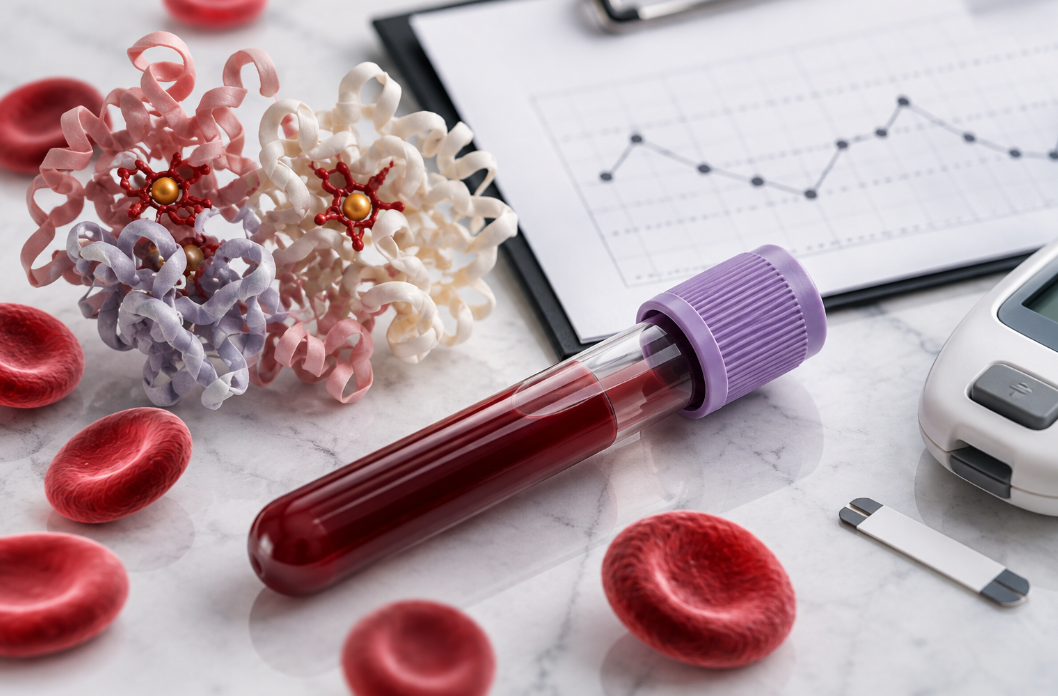
Glycated Hemoglobin (HbA1c): What the Test Shows and How to Interpret the Results
Glycated hemoglobin, or HbA1c, is one of the most important laboratory tests used to assess blood glucose levels.
Unlike a standard blood glucose measurement, which reflects glucose concentration at a specific point in time, HbA1c provides information about glycemic exposure over approximately the previous 2–3 months. 1
It is used both to diagnose prediabetes and diabetes and to monitor people who have already been diagnosed with diabetes. 1, 2
What is HbA1c?
Hemoglobin is the protein found in red blood cells that is involved in transporting oxygen.
Glucose circulating in the blood can bind non-enzymatically to hemoglobin. The proportion of hemoglobin that has undergone this process is expressed as HbA1c.
The higher the average blood glucose level over a period of time, the higher the HbA1c level tends to be. 1
Red blood cells circulate for approximately 120 days, but HbA1c is not simply a numerical average of glucose levels over 120 days. It is influenced more strongly by more recent glycemic exposure, which is why significant changes in blood glucose can begin to affect HbA1c before four months have passed. 1
What does the test show?
HbA1c is used for two main purposes:
Diagnosis of prediabetes and diabetes
In nonpregnant individuals, the American Diabetes Association (ADA) includes HbA1c among the tests that can be used to diagnose diabetes. 1
Monitoring diabetes
In people with established diabetes, the test helps assess glycemic control over time and is used alongside other information, such as blood glucose measurements and, when used, continuous glucose monitoring (CGM). 2
However, HbA1c does not show daily fluctuations in blood glucose or indicate whether someone experiences frequent episodes of hypoglycemia or marked post-meal glucose spikes. 2
How is the test performed?
HbA1c is measured using a whole-blood sample.
It is usually performed using blood drawn from a vein. Point-of-care devices that measure HbA1c using capillary blood are also available. However, when HbA1c is used for diagnosis, it is important that an appropriately certified and standardized method is used. 1
One of the advantages of the test is that:
Fasting is not required.
What someone has eaten in the hours before the blood draw does not directly alter HbA1c, unlike a fasting glucose measurement or an oral glucose tolerance test. 1
How are HbA1c values interpreted?
According to the ADA Standards of Care in Diabetes 2026, the following diagnostic thresholds are used for nonpregnant individuals: 1
| HbA1c | Interpretation |
|---|---|
| <5.7% | Does not meet the criteria for prediabetes |
| 5.7–6.4% | Prediabetes |
| ≥6.5% | Diagnostic threshold for diabetes |
An HbA1c of 6.5% corresponds to 48 mmol/mol.
However, there is an important detail: in a person without unequivocal hyperglycemia, a single abnormal result is generally not sufficient to confirm the diagnosis.
Two abnormal results are required, either from the same test performed at different times or from two different diagnostic tests. For example, HbA1c may be repeated, or a plasma glucose test may be used. 1
If two different tests produce conflicting results, the test result that is above the diagnostic threshold should be reassessed, and possible factors affecting the measurement should be investigated. 1
What is the HbA1c target for someone with diabetes?
The 6.5% value is a diagnostic threshold and should not be confused with the treatment target for a person who already has diabetes.
For many nonpregnant adults with diabetes, the ADA considers the following an appropriate target:
HbA1c <7%
However, the target should be individualized. 2
For some people, a lower target, such as <6.5%, may be appropriate if it can be achieved safely. For others, a less stringent target may be more appropriate depending on factors such as age, comorbidities, frailty, the risk of hypoglycemia, and treatment-related factors. 2
When might HbA1c not accurately reflect blood glucose?
This is one of the most important considerations when interpreting the test.
HbA1c depends not only on blood glucose but also on red blood cells and their lifespan. Therefore, conditions that alter the production, destruction, or lifespan of red blood cells can also affect the result. 1, 3
The ADA Standards of Care 2026 list several conditions that may affect the relationship between HbA1c and actual glycemia, including:
– anemia and changes in iron status
– hemolysis
– recent significant blood loss
– blood transfusion
– erythropoietin therapy
– certain hemoglobinopathies
– kidney failure and dialysis
– pregnancy
– some cases of liver disease
– G6PD deficiency and certain other conditions. 1
Iron deficiency anemia
Iron deficiency is a particularly important example.
The NGSP states that significant iron deficiency anemia has been associated with higher HbA1c levels, while iron replacement therapy may reduce HbA1c. 3
However, the literature is not entirely consistent. A recent review notes that both increased HbA1c values and studies showing no significant effect have been reported. 4
In a systematic review examining iron deficiency anemia during pregnancy, six of the seven included studies reported a positive association between iron deficiency anemia and HbA1c. 5
Therefore, when significant iron deficiency is present, HbA1c should be interpreted with caution.
Blood loss and hemolysis
Conditions that reduce the average age of red blood cells, such as hemolysis or recovery following significant blood loss, tend to produce artificially lower HbA1c levels because the red blood cells do not remain in circulation long enough to become glycated to the same extent. 3
Blood transfusion
Following a recent blood transfusion, HbA1c may not reliably reflect the patient’s own glycemic status.
For this reason, it is not accurate to say that blood transfusion always causes a “falsely elevated” or always a “falsely low” HbA1c result. The effect depends on several factors. 1, 4
Hemoglobinopathies
Hemoglobin variants such as HbS, HbC, HbE, and HbD can interfere with some methods used to measure HbA1c.
The effect depends on the specific variant and the laboratory method being used. 3
A 2024 study evaluating different analytical methods confirmed that specific hemoglobin variants can cause varying degrees of interference depending on the assay used. 6
Chronic kidney disease
In advanced chronic kidney disease, particularly in patients undergoing dialysis, HbA1c can also be more difficult to interpret because of anemia, changes in red blood cell lifespan, and treatments such as erythropoietin. 1, 4
A recent 2026 review highlights that in advanced kidney disease, HbA1c may show clinically important discrepancies from actual glycemic exposure. 7
What about pregnancy?
Pregnancy is a separate clinical situation.
Because red blood cell turnover increases during pregnancy, HbA1c tends to be slightly lower during pregnancy. 8
The ADA emphasizes that HbA1c should not be the primary tool used to monitor glucose during pregnancy. Monitoring fasting and post-meal glucose levels is more important, while HbA1c is used as a supplementary measure. 8
For this reason, the usual diagnostic and treatment thresholds used in nonpregnant individuals should not be applied automatically during pregnancy.
What happens when HbA1c and blood glucose do not match?
If, for example, daily blood glucose measurements appear normal but HbA1c is unexpectedly high, or the opposite occurs, the discrepancy should not be ignored.
ADA guidelines recommend investigating the possibility of interference or a clinical factor that alters the relationship between HbA1c and blood glucose. 1
Depending on the individual situation, a doctor may use:
– plasma glucose
– an oral glucose tolerance test
– self-monitoring of blood glucose
– continuous glucose monitoring (CGM)
– fructosamine
– glycated albumin. 1, 2, 4
A recent 2026 review on discordance between HbA1c and actual glycemia highlights anemia, hemoglobinopathies, and chronic kidney disease as important causes of this mismatch. 4
Conclusion
HbA1c is a particularly useful test because it provides an indication of glycemic exposure over approximately 2–3 months without requiring fasting.
According to the ADA, in nonpregnant individuals:
HbA1c 5.7–6.4% falls within the prediabetes range, while HbA1c ≥6.5% is a diagnostic threshold for diabetes. 1
However, HbA1c should not be interpreted as an isolated number without considering the broader clinical context. Red blood cell lifespan, anemia, iron deficiency, hemoglobinopathies, kidney disease, pregnancy, recent blood loss or transfusion, and other factors can affect the result.
For this reason, an HbA1c result should always be interpreted alongside the patient’s medical history, other laboratory tests, and, when necessary, direct measurements of blood glucose.
Sources
[1] American Diabetes Association Professional Practice Committee for Diabetes. Diagnosis and Classification of Diabetes: Standards of Care in Diabetes—2026. Diabetes Care. 2026;49(Suppl 1):S27–S49.
ADA Standards of Care 2026 – Diagnosis and Classification
[2] American Diabetes Association Professional Practice Committee for Diabetes. Glycemic Goals, Hypoglycemia, and Hyperglycemic Crises: Standards of Care in Diabetes—2026. Diabetes Care. 2026;49(Suppl 1):S132–S149.
ADA Standards of Care 2026 – Glycemic Goals
[3] National Glycohemoglobin Standardization Program (NGSP). Factors that Interfere with HbA1c Test Results. Updated June 23, 2026.
NGSP – Factors that Interfere with HbA1c
[4] Sureshkumar P, Kumar SS, Anusree E, Cheriyan J, Masood A. Navigating the discordance: a comprehensive review of HbA1c-glycemia mismatch in clinical practice. Diabetes Res Clin Pract. 2026;235:113216. PMID: 41856328.
PubMed – HbA1c-Glycemia Mismatch Review
[5] AlQarni AM, et al. Exploring the Impact of Iron Deficiency Anaemia on Glycated Haemoglobin A1c Levels in Pregnant and Non-Pregnant Women: A Systematic Review. Int J Womens Health. 2024;16:797–809. PMID: 38765207.
PubMed – Iron Deficiency and HbA1c Systematic Review
[6] Song Y, et al. Evaluation of effects from hemoglobin variants on HbA1c measurements by different methods. Clin Chem Lab Med. 2024;62(10):2082–2090. PMID: 38563053.
PubMed – Hemoglobin Variants and HbA1c Methods
[7] Zhang F, Wu R, Bai Y, Zhong Y. Glycemic instability in renal decline: a review of HbA1c variability and outcomes in chronic kidney disease. Diabetol Metab Syndr. 2026. PMID: 42482210.
PubMed – HbA1c and Chronic Kidney Disease Review
[8] American Diabetes Association Professional Practice Committee for Diabetes. Management of Diabetes in Pregnancy: Standards of Care in Diabetes—2026. Diabetes Care. 2026;49(Suppl 1):S321–S338.
ADA 2026 – Diabetes in Pregnancy
Comments
💬 Join the discussion