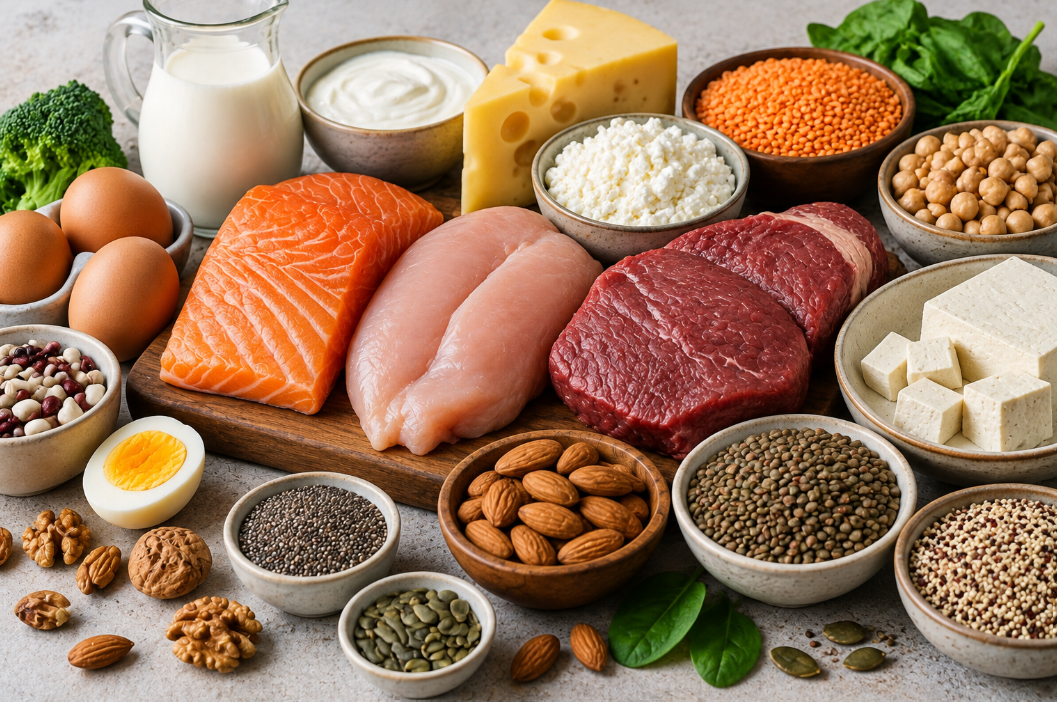
Protein is one of the essential nutrients in our diet. It plays a role in building and maintaining muscle and other tissues, as well as in the production of enzymes, hormones, antibodies, and many other molecules that are essential for the body to function properly.
But how much protein do we actually need each day?
There is no single number of grams that is appropriate for everyone. Protein requirements are influenced by body weight, age, physical activity, pregnancy, breastfeeding, and health status. 1, 4
What is protein?
Proteins are made up of smaller building blocks called amino acids.
The human body can produce some of these amino acids, but others must be obtained through the diet and are therefore known as essential amino acids.
Proteins are involved in many functions, including:
- building and maintaining muscle mass
- providing structure to the skin and other tissues
- supporting immune system function
- producing enzymes
- producing several hormones
- transporting various substances throughout the body.
Adequate protein intake is therefore essential at every stage of life.
How much protein does an adult need per day?
The European Food Safety Authority (EFSA) has established a Population Reference Intake (PRI) for healthy adults of:
0.83 grams of protein per kilogram of body weight per day. 1
The PRI is a reference intake designed to meet the requirements of the vast majority of healthy people in a population. It is not an “upper limit” for protein intake. 1
A simple calculation is:
Body weight in kg × 0.83 = grams of protein per day
For example:
| Body weight | Protein PRI |
|---|---|
| 50 kg | approximately 42 g/day |
| 60 kg | approximately 50 g/day |
| 70 kg | approximately 58 g/day |
| 80 kg | approximately 66 g/day |
| 90 kg | approximately 75 g/day |
These figures represent the general reference intake for healthy adults. They are not individualized dietary targets for every person, as protein requirements may differ depending on age, physical activity level, and health status.
Do people who do resistance training need more protein?
Resistance training is a major stimulus for increasing muscle mass, and adequate protein intake can enhance muscular adaptations to training.
A large systematic review and meta-analysis of 74 randomized controlled trials found that increasing daily protein intake could enhance gains in lean body mass, particularly when combined with resistance exercise. 2
Another meta-analysis of 49 studies involving a total of 1,863 participants found that additional protein intake enhanced gains in muscle mass and strength during resistance training. 3
In the same analysis, increasing total protein intake beyond approximately 1.6 g of protein/kg/day was not associated, on average, with further increases in fat-free mass. 3
This has an important practical interpretation:
The 0.83 g/kg/day value represents the reference intake for meeting the basic protein requirements of healthy adults, whereas approximately 1.6 g/kg/day is a target supported by evidence for people seeking to maximize muscular adaptations to resistance training.
This does not mean that everyone who goes to the gym needs to consume exactly this amount.
Resistance training itself also remains a much more potent stimulus for muscle growth than simply increasing protein intake. 3
What about older adults?
As we age, maintaining muscle mass and physical function becomes particularly important.
Although EFSA’s general reference value for adults is 0.83 g/kg/day, 1 the European Society for Clinical Nutrition and Metabolism (ESPEN) recommends that older people consume at least 1.0 g of protein per kilogram of body weight per day. 4
The amount should be adjusted according to:
- nutritional status
- physical activity level
- the presence of disease
- individual tolerance. 4
For healthy older adults, intakes of approximately 1.0–1.2 g/kg/day have been suggested. 4
Therefore, the protein needs of a 70-year-old are not necessarily the same as those of a healthy younger adult with the same body weight.
What about pregnancy and breastfeeding?
Protein requirements also increase during pregnancy.
In addition to the intake that would apply to a nonpregnant woman, EFSA recommends: 1
- an additional 1 g of protein/day during the first trimester
- an additional 9 g/day during the second trimester
- an additional 28 g/day during the third trimester.
During breastfeeding, the recommended additional intake is:
- an additional 19 g/day during the first six months
- an additional 13 g/day after the first six months. 1
These amounts are population-level recommendations and do not replace individualized nutritional guidance during pregnancy or breastfeeding.
What are the best sources of protein?
Protein is found in both animal- and plant-based foods.
Major animal sources include:
- fish and seafood
- poultry
- meat
- eggs
- milk
- yogurt
- cheese.
Plant-based sources include:
- lentils
- beans
- chickpeas
- soy
- tofu
- tempeh
- nuts
- seeds
- grains. 5
The “best” source of protein is not determined solely by how many grams of protein a food contains. Its overall nutritional profile and how it fits into the diet as a whole also matter.
For example, legumes provide fiber in addition to protein, while fish can provide omega-3 fatty acids and other important nutrients.
15 foods that contain protein
The amounts below are approximate and are based on food composition data from USDA FoodData Central. 6 Exact protein content can vary depending on the type of food, processing, cooking method, and specific product.
| Food | Approximate serving | Approximate protein |
|---|---|---|
| Chicken breast, cooked | 100 g | ≈30–31 g |
| Tuna | 100 g | ≈25–29 g |
| Lean beef, cooked | 100 g | ≈25–30 g |
| Salmon | 100 g | ≈20–25 g |
| Strained or high-protein yogurt | 200 g | ≈18–20 g |
| Cottage cheese | 150 g | ≈17–20 g |
| Eggs | 2 large | ≈12–13 g |
| Lentils, cooked | 1 cup | ≈18 g |
| Edamame, cooked | 1 cup | ≈17–18 g |
| Beans, cooked | 1 cup | ≈14–16 g |
| Chickpeas, cooked | 1 cup | ≈14–15 g |
| Tempeh | 100 g | ≈19–20 g |
| Tofu | 100 g | ≈10–17 g |
| Almonds | 30 g | ≈6 g |
| Oats | 50 g dry | ≈6–7 g |
Note: Products such as yogurt, cottage cheese, and tofu can vary considerably depending on the brand and production method. For a specific product, the nutrition label is the best source of information.
Can we get enough protein from plant foods alone?
Yes. A well-planned diet can meet protein and essential amino acid requirements using plant-based sources.
The Nordic Nutrition Recommendations 2023 state that both animal proteins and combinations of different plant protein sources, such as legumes and grains, can provide a good distribution of essential amino acids. 5
Protein quality and digestibility vary between foods, so adequate total protein intake and a variety of protein sources are important in a plant-based diet.
A recent meta-analysis of 43 randomized controlled trials found a small advantage of animal protein over some plant proteins for muscle mass, but found no significant difference in muscle strength or physical performance. When soy protein was specifically compared with milk protein, no significant difference in muscle mass was observed. 7
The picture is therefore more complex than simply classifying animal protein as “good” and plant protein as “bad.”
Do we need protein supplements?
Most people can meet their protein requirements through food.
Protein powders, such as whey, casein, or plant-based protein powders, can be a convenient way to increase protein intake when someone finds it difficult to meet their target through food alone.
However, they are not essential for increasing muscle mass.
In resistance-training studies, what appears to matter most is total daily protein intake combined with resistance training itself, rather than whether the protein necessarily comes from a supplement. 2, 3
Does all protein need to be consumed in one meal?
In practical terms, it is usually easier to distribute protein across several meals throughout the day.
A breakfast containing yogurt or eggs, a lunch containing legumes, fish, or meat, and a dinner that also includes a source of protein can all help meet total daily protein needs.
Especially when the goal is muscle growth, the most important factors remain adequate total protein intake over the course of the day and appropriate resistance training.
So, how much protein do we need?
There is no single number that applies to everyone.
For healthy adults, the basic European reference intake is:
0.83 g/kg of body weight/day. 1
For older adults, ESPEN recommends:
at least 1.0 g/kg/day, with an intake of approximately 1.0–1.2 g/kg/day often suggested for healthy older people. 4
For people who regularly perform resistance training and aim to maximize muscle growth, the available evidence suggests that a total intake of around:
1.6 g/kg/day
Is an evidence-based practical target, while higher intakes have not, on average, been shown to provide additional benefits for gains in fat-free mass. 3
These figures do not contradict one another. They answer different questions and apply to different populations and goals.
Conclusion
Protein is an essential nutrient, but the amount we need depends on who we are and what we are trying to achieve.
For a healthy adult, EFSA has established a Population Reference Intake of 0.83 g/kg/day, while older adults and people who regularly engage in resistance training may have reason to consume higher amounts.
Protein also does not need to come from one particular food or from a supplement. Fish, eggs, dairy products, meat, legumes, soy, nuts, and grains can all contribute to daily protein intake.
What matters is adequate total protein intake and a variety of foods within a balanced diet.
Sources
[1] EFSA Panel on Dietetic Products, Nutrition and Allergies (NDA). Scientific Opinion on Dietary Reference Values for protein. EFSA Journal. 2012;10(2):2557. EFSA establishes a PRI of 0.83 g/kg/day for adults and additional protein requirements during pregnancy and breastfeeding.
EFSA – Dietary Reference Values for Protein
[2] Nunes EA, Colenso-Semple L, McKellar SR, et al. Systematic review and meta-analysis of protein intake to support muscle mass and function in healthy adults. Journal of Cachexia, Sarcopenia and Muscle. 2022;13(2):795–810. Systematic review and meta-analysis of 74 randomized controlled trials.
PubMed – Nunes et al.
[3] Morton RW, Murphy KT, McKellar SR, et al. A systematic review, meta-analysis and meta-regression of the effect of protein supplementation on resistance training-induced gains in muscle mass and strength in healthy adults. British Journal of Sports Medicine. 2018;52:376–384.
British Journal of Sports Medicine – Morton et al.
[4] Volkert D, Beck AM, Cederholm T, et al. ESPEN practical guideline: Clinical nutrition and hydration in geriatrics. Clinical Nutrition. 2022;41:958–989.
ESPEN – Clinical Nutrition and Hydration in Geriatrics
[5] Nordic Council of Ministers. Nordic Nutrition Recommendations 2023 – Protein.
Nordic Nutrition Recommendations 2023 – Protein
[6] U.S. Department of Agriculture, Agricultural Research Service. FoodData Central. Food composition and nutrient database.
USDA FoodData Central
[7] Reid-McCann RJ, Brennan SF, Ward NA, et al. Effect of Plant Versus Animal Protein on Muscle Mass, Strength, Physical Performance, and Sarcopenia: A Systematic Review and Meta-analysis of Randomized Controlled Trials. Nutrition Reviews. 2025;83(7):e1581–e1603.
PubMed – Reid-McCann et al. 2025
Comments
💬 Join the discussion