How Does the Vaccine Work?
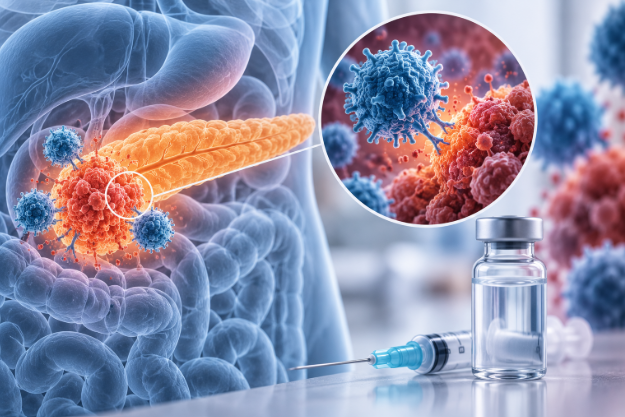
Camupepimut (ELI-002 7P) is an experimental therapeutic vaccine designed to target seven mutations in the KRAS protein.
Mutations in the KRAS gene are found in approximately 90% of pancreatic ductal adenocarcinomas and contribute to the uncontrolled growth of cancer cells.
The vaccine is designed to activate T cells that recognise these mutations, helping the immune system identify cancer cells that carry them.
It is a form of immunotherapy rather than a preventive vaccine, unlike vaccines against HPV and hepatitis B, which can reduce the risk of developing certain types of cancer.
How Was the Study Conducted?
AMPLIFY-7P was a randomised phase 2 clinical trial involving 144 patients with stage I–III pancreatic cancer carrying KRAS mutations.
All participants had completed standard treatment, including surgery and chemotherapy, and had no visible evidence of recurrence when they entered the study.
They were randomly assigned to two groups:
- 96 patients received the experimental vaccine.
- 48 patients were monitored without receiving the vaccine.
The aim was to determine whether the treatment could extend disease-free survival, the length of time before cancer recurrence or death.
What Did the Study Find?
The researchers initially found that 89 of the 90 evaluable patients (98.9%) developed an increased immune response against the KRAS mutations.
However, activating the immune system does not necessarily translate into better clinical outcomes.
Median disease-free survival was:
- 23.8 months in the vaccine group.
- 21.2 months in the observation group.
The difference was not statistically significant (p = 0.5329).
Therefore, the study did not demonstrate that the vaccine improved disease-free survival in the overall study population.
Nevertheless, some subgroup analyses suggested a possible benefit, particularly among patients who had no detectable circulating tumour DNA (ctDNA) at baseline and those who had not previously received radiotherapy. [1]
What Are the Study’s Limitations?
Although randomisation is an important strength, the study had a relatively small sample size and was open-label, meaning that participants and researchers knew which treatment was being given.
Furthermore, findings from subgroup analyses are not sufficient to establish treatment effectiveness, particularly when the trial has not met its primary endpoint.
Mature overall survival data are not yet available. In addition, the observed association between a stronger immune response and longer disease-free survival does not establish a causal relationship.
The vaccine is being developed by Elicio Therapeutics, a company with a commercial interest in the treatment’s development. [2]
Conclusion
The study showed that camupepimut can trigger a strong immune response against KRAS mutations in patients with pancreatic cancer.
However, it has not yet been demonstrated that the vaccine reduces the risk of recurrence or improves survival.
The findings provide valuable information for the design of a larger phase 3 clinical trial, which will further evaluate the treatment’s effectiveness.