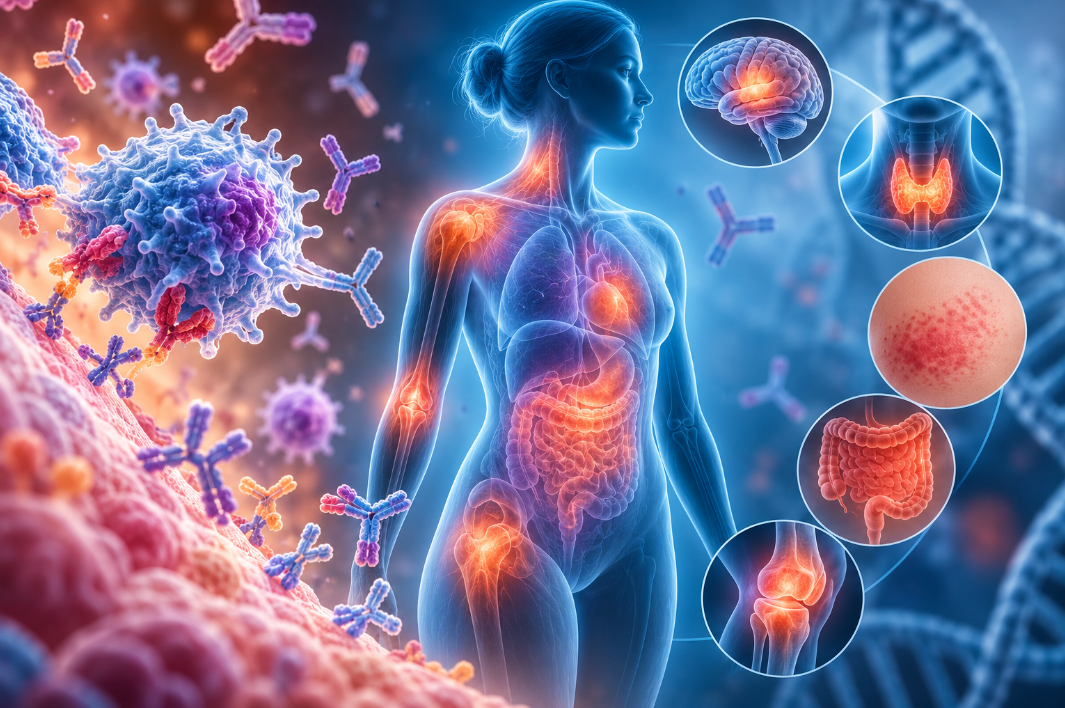
Autoimmune diseases are a large and diverse group of conditions that can affect almost any organ or tissue in the human body. They develop when the immune system mistakenly targets the body’s own components, causing inflammation, cellular damage, or disruption of normal tissue function.
Although research has uncovered important mechanisms involved in their development, the exact causes of many autoimmune diseases remain unknown.
What Are Autoimmune Diseases?
The immune system is a complex network of cells, tissues, and molecules that protects the body against pathogens and other potentially harmful threats.
Under normal circumstances, it has mechanisms that allow it to distinguish the body’s own components from those that may pose a threat.
This ability is known as immune tolerance.
In autoimmune diseases, some of these mechanisms fail to function properly. As a result, autoreactive T cells, B cells, or autoantibodies can contribute to damage in otherwise healthy tissues.
It is important to understand that autoimmune responses do not occur in the same way across all conditions.
In some cases, the immune system targets a specific organ, such as the thyroid gland. In others, the immune response can affect multiple organs and systems.
The loss of immune tolerance is considered a central mechanism in the development of autoimmunity. However, the underlying processes vary considerably between diseases. [1]
How Common Are Autoimmune Diseases?
More than 80 autoimmune diseases are currently recognised.
A large population-based study published in The Lancet in 2023 analysed data from more than 22 million people in the United Kingdom.
The researchers found that the 19 autoimmune diseases included in the study affected approximately 10.2% of the population over the study period.
Overall, autoimmune diseases were diagnosed more frequently in women than in men, although the distribution varied between individual conditions. [2]
The higher prevalence of several autoimmune diseases among women has been linked to genetic, hormonal, and immunological mechanisms.
In particular, sex-related differences in immune system function remain an active area of research. [3]
What Are the Main Types of Autoimmune Diseases?
Autoimmune diseases can be classified in several ways, including according to the organs and tissues they affect.
One important distinction is between organ-specific and systemic autoimmune diseases.
1. Organ-Specific Autoimmune Diseases
In these conditions, the autoimmune response primarily targets a particular organ or tissue.
Examples include:
Hashimoto’s Thyroiditis: The immune system attacks the thyroid gland, causing chronic inflammation and often leading to hypothyroidism.
Graves’ Disease: Autoantibodies stimulate the thyroid-stimulating hormone (TSH) receptor, causing excessive production of thyroid hormones.
Type 1 Diabetes: Autoimmune destruction of pancreatic beta cells leads to a severe deficiency in insulin production.
Coeliac Disease: A chronic immune-mediated enteropathy that develops in genetically susceptible individuals following exposure to gluten.
Myasthenia Gravis: An autoimmune disorder affecting the neuromuscular junction, in which autoantibodies interfere with normal neuromuscular transmission.
Vitiligo: A condition in which immune mechanisms contribute to the destruction of melanocytes, resulting in a loss of normal skin pigmentation.
2. Systemic Autoimmune Diseases
Systemic autoimmune diseases can affect more than one organ or body system.
Examples include:
Systemic Lupus Erythematosus (SLE): A condition that can affect the skin, joints, kidneys, blood, nervous system, and other organs.
Rheumatoid Arthritis: A chronic autoimmune inflammatory disease that primarily affects the joints but can also cause symptoms and complications outside them.
Systemic Sclerosis: Characterised by vascular and immune abnormalities and fibrosis, which can affect the skin and internal organs.
Sjögren’s Syndrome: Commonly affects the tear-producing and salivary glands, causing dry eyes and dry mouth. It can also involve other organs and systems.
Autoimmune Vasculitis: A group of conditions characterised by immune-mediated inflammation of blood vessels.
3. Autoimmune Diseases of the Nervous System
Some autoimmune or immune-mediated diseases primarily affect the nervous system.
One example is multiple sclerosis (MS), in which immune mechanisms cause inflammatory demyelination and damage to nerve fibres within the central nervous system.
Multiple sclerosis is considered an autoimmune or immune-mediated disease, although the precise mechanisms responsible for its development are still being investigated.
Other examples include certain forms of autoimmune encephalitis and autoimmune neuropathies.
It is important to distinguish autoimmune diseases from other chronic inflammatory conditions, as not all inflammatory diseases are strictly autoimmune.
For example, psoriasis and inflammatory bowel diseases are more commonly classified as immune-mediated conditions because their underlying mechanisms extend beyond a classical autoimmune response.
What Are the Symptoms of Autoimmune Diseases?
Symptoms largely depend on which organ or body system is affected.
Because autoimmune diseases are so diverse, there is no single set of symptoms that applies to every condition.
However, some symptoms occur across several autoimmune diseases.
General Symptoms
Certain autoimmune diseases may cause:
- Persistent fatigue or exhaustion.
- Joint pain and stiffness.
- Muscle pain or weakness.
- Skin rashes.
- Unexplained changes in body weight.
- Low-grade fever.
- Difficulty concentrating.
- A general feeling of being unwell.
Symptoms Depending on the Affected Organ
Thyroid: Fatigue, weight changes, intolerance to cold or heat, rapid heartbeat, and metabolic disturbances.
Joints: Pain, swelling, morning stiffness and reduced mobility.
Digestive System: Abdominal pain, diarrhoea, bloating, malabsorption and weight loss.
Nervous System: Muscle weakness, sensory disturbances, vision problems or difficulties with movement.
Skin: Rashes, loss of pigmentation, sensitivity to sunlight or other skin changes.
The severity and duration of symptoms can vary.
Many autoimmune diseases involve periods of increased disease activity, known as flares, alternating with periods of reduced activity or remission.
However, not all autoimmune diseases follow the same clinical course.
Furthermore, fatigue, muscle pain, and other non-specific symptoms can occur in many different medical conditions. Their presence alone is therefore not enough to diagnose an autoimmune disease. [12]
What Causes Autoimmune Diseases?
The exact causes of most autoimmune diseases are not yet fully understood.
The prevailing scientific understanding is that they develop through complex interactions between genetic susceptibility, immunological mechanisms, and environmental factors.
Genetic Predisposition
Genetic predisposition plays an important role in the development of many autoimmune diseases.
Certain genetic variants, particularly those involving genes associated with immune system function, can increase the risk of developing autoimmunity.
Notable examples include specific variants of genes within the human leukocyte antigen (HLA) system.
However, having a genetic predisposition does not necessarily mean that someone will develop an autoimmune disease.
Most autoimmune diseases do not follow a simple, single-gene pattern of inheritance. [1]
Loss of Immune Tolerance
Under normal circumstances, the immune system has mechanisms that prevent or limit the activity of autoreactive lymphocytes.
These include central and peripheral immune tolerance, as well as the function of regulatory T cells.
When these mechanisms are disrupted, immune responses against the body’s own cells and tissues may become activated.
The production of autoantibodies is an important feature of many autoimmune diseases, but it is not a requirement for every form of autoimmunity. [1]
Hormonal and Biological Factors
Several autoimmune diseases are more common in women.
This difference is thought to involve multiple factors, including sex chromosomes, hormonal influences, and differences in innate and adaptive immune system function.
However, the exact mechanisms and the relative contribution of each factor are still being investigated. [3]
What Can Trigger the Development of an Autoimmune Disease?
Genetic predisposition alone is often not enough for an autoimmune disease to develop.
Research suggests that various environmental factors may contribute to the development of autoimmunity in susceptible individuals.
1. Viral and Other Infections
Certain infections have been associated with the development of autoimmune diseases.
One of the most important examples involves the Epstein–Barr virus (EBV) and multiple sclerosis.
In a large prospective study published in Science in 2022, researchers analysed data from more than 10 million young adults serving in the US military.
The study found that the risk of developing multiple sclerosis increased approximately 32-fold following EBV infection.
This finding supports an important causal role for EBV in the development of multiple sclerosis.
However, EBV infection is extremely common in the general population, whereas multiple sclerosis is far less common. [4]
2. Smoking
Smoking is one of the best-established modifiable risk factors for rheumatoid arthritis.
A meta-analysis published in Arthritis Research & Therapy in 2014 examined the relationship between cumulative smoking exposure and the risk of developing rheumatoid arthritis.
The researchers found that the risk increased with greater exposure to tobacco smoke.
Compared with people who had never smoked, those with a smoking history of 21–30 pack-years had almost twice the relative risk of developing the disease.
The association was particularly strong for certain seropositive forms of rheumatoid arthritis. [5]
These findings highlight the importance of avoiding smoking, although they do not mean that everyone who smokes will develop an autoimmune disease.
3. Environmental and Occupational Factors
Exposure to certain environmental factors has also been associated with an increased risk of autoimmunity.
For example, a systematic review and meta-analysis published in 2020 examined the relationship between occupational exposure to crystalline silica and systemic lupus erythematosus.
The researchers found a positive association, particularly in occupational settings involving high levels of exposure.
However, the available studies showed considerable heterogeneity, limiting the certainty of the conclusions. [6]
4. Dietary Factors
Diet can influence immune system function, but its role in the initial development of autoimmune diseases varies considerably between conditions.
One well-established example is coeliac disease.
In genetically susceptible individuals, consuming gluten triggers an abnormal immune response that damages the small intestine.
However, gluten has not been shown to be a general cause of all autoimmune diseases.
Avoiding specific foods without a relevant medical diagnosis is not an evidence-based strategy for preventing autoimmunity. [7]
5. Psychological Stress
The relationship between psychological stress and autoimmune diseases has been the subject of considerable scientific research.
In 2018, a large Swedish study published in JAMA examined more than 100,000 individuals diagnosed with stress-related disorders.
The researchers found that these individuals had an increased risk of subsequently being diagnosed with an autoimmune disease compared with people without such disorders.
However, the study was observational and could not establish that psychological stress directly causes autoimmune diseases.
Importantly, it examined clinically diagnosed stress-related disorders rather than everyday stress. [8]
6. Certain Medications
Some medications can trigger autoimmune reactions in certain circumstances.
One example is drug-induced lupus, which has been associated with medications such as hydralazine and procainamide.
This condition differs from idiopathic systemic lupus erythematosus and usually improves after the medication responsible is discontinued under medical supervision. [9]
Such reactions are associated with specific medications and do not mean that medications in general cause autoimmunity.
7. Factors That Can Trigger Disease Flares
It is important to distinguish between factors involved in the initial development of an autoimmune disease and those that can worsen an existing condition.
For example, ultraviolet (UV) radiation is a recognised trigger of skin-related and systemic flares in people with systemic lupus erythematosus.
For this reason, recommendations from the European Alliance of Associations for Rheumatology (EULAR) place particular emphasis on sun protection for people with lupus. [10]
In other autoimmune diseases, the factors associated with flares may be different.
There is therefore no single trigger that applies to every autoimmune condition.
How Are Autoimmune Diseases Diagnosed?
Diagnosing an autoimmune disease involves combining a clinical assessment with appropriate laboratory tests or imaging studies.
There is no single blood test that can diagnose every autoimmune disease.
The diagnostic process usually involves reviewing symptoms, personal and family medical history, performing a physical examination, and ordering more targeted tests based on the suspected condition.
Laboratory Tests
The tests used depend on which autoimmune disease is suspected.
Antinuclear Antibodies (ANA): Mainly used when investigating systemic autoimmune diseases, such as systemic lupus erythematosus.
Specific Autoantibodies: These include anti-dsDNA and anti-Sm antibodies when investigating lupus, anti-CCP antibodies in rheumatoid arthritis, and anti-TPO antibodies in autoimmune thyroid disorders.
Inflammatory Markers: C-reactive protein (CRP) and erythrocyte sedimentation rate (ESR) can help assess inflammatory activity, but neither is specific to autoimmune diseases.
Organ Function Tests: Depending on the suspected condition, tests may be needed to assess thyroid function, kidney function, liver enzymes, a full blood count, and urine analysis.
In some cases, additional imaging, endoscopy, or a tissue biopsy may also be required. [11,19,20,21]
How Are Autoimmune Diseases Treated?
Treatment depends on the specific autoimmune disease, its severity, the organs affected, and the patient’s overall health.
1. Anti-inflammatory and Immunomodulatory Medications
Many autoimmune diseases are treated with medications that reduce inflammation or modify immune system activity.
Depending on the condition, treatment may include:
- Corticosteroids.
- Conventional immunomodulatory or immunosuppressive medications, such as methotrexate and azathioprine.
- Biological therapies that target specific immune cells or molecules.
- Targeted small-molecule therapies, including certain Janus kinase (JAK) inhibitors.
[13]
2. Disease-Specific Treatments
Not all autoimmune diseases require generalised immunosuppression.
In Hashimoto’s thyroiditis, when hypothyroidism is present, treatment usually involves levothyroxine to replace deficient thyroid hormones.
In type 1 diabetes, insulin treatment is essential.
For coeliac disease, a strict, lifelong gluten-free diet is the established treatment.
By contrast, certain systemic autoimmune diseases require specialised immunomodulatory therapies and close medical monitoring. [14,15]
3. Lifestyle Changes
Lifestyle changes can play an important supporting role in managing autoimmune diseases.
A balanced diet, appropriate physical activity, avoiding smoking, and addressing other risk factors can all contribute to better overall health.
However, there is no single diet that has been proven to cure all autoimmune diseases.
Similarly, dietary supplements are generally not a substitute for recommended medical treatments.
People taking immunosuppressive medications also require an individual assessment of their infection risk and vaccination needs. [13,14,16]
What Do Emerging Treatments Show?
In recent years, researchers have been investigating new treatment approaches aimed at restoring immune tolerance or eliminating specific populations of autoreactive immune cells.
One particularly promising area of research involves chimeric antigen receptor T-cell (CAR-T) therapies.
In 2024, a study published in The New England Journal of Medicine reported findings from 15 patients with severe systemic autoimmune diseases, including lupus, systemic sclerosis, and inflammatory myopathies.
The researchers observed substantial clinical responses, with several patients achieving remission without ongoing immunosuppressive treatment during the follow-up period.
However, the study involved a small number of patients and could not establish whether the treatment could provide a permanent, long-term cure. [17]
Developing more targeted treatments capable of restoring immune tolerance remains an important goal of modern autoimmune disease research. [18]