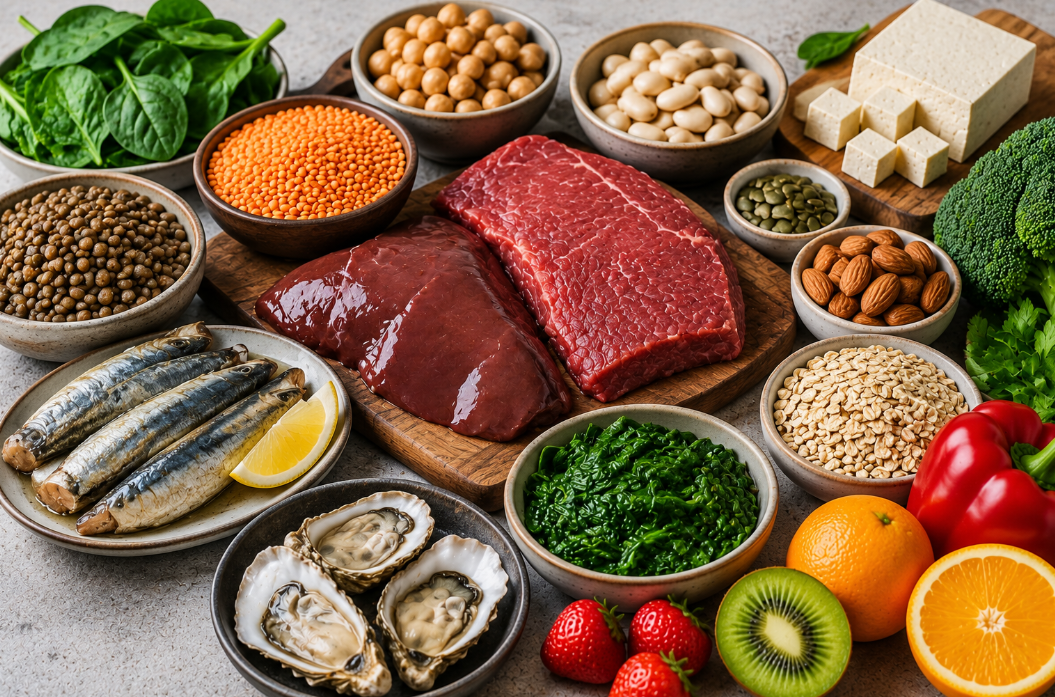
Iron is an essential mineral that we need to obtain from our diet every day. It is found in both animal- and plant-based foods, but the amount of iron a food contains is not the only factor that matters: the body does not absorb all forms of iron in the same way.
So, how much iron do we need each day? Which foods contain the highest amounts, and how can we improve its absorption?
Why do we need iron?
Iron is an essential component of hemoglobin, the protein in red blood cells that carries oxygen from the lungs to the body’s tissues.
It is also a component of myoglobin, which helps supply oxygen to muscles, and is required for a range of cellular functions, growth, and the synthesis of certain hormones. 1, 2
When iron stores become significantly depleted, iron deficiency can develop and, at a more advanced stage, may lead to iron-deficiency anemia.
How much iron do we need per day?
Iron requirements are not the same for everyone.
According to the European Food Safety Authority (EFSA), the Population Reference Intake (PRI) for iron is: 1
| Group | Iron |
|---|---|
| Adult men | 11 mg/day |
| Premenopausal women | 16 mg/day |
| Postmenopausal women | 11 mg/day |
| Boys aged 12–17 years | 11 mg/day |
| Girls aged 12–17 years | 13 mg/day |
The higher requirements in premenopausal women are mainly related to iron losses through menstruation. 1
EFSA also sets a PRI of 16 mg/day during pregnancy and breastfeeding, the same value as for premenopausal women. This approach is based on the assumption that physiological adaptations during pregnancy, including increased iron absorption, together with existing iron stores, contribute to meeting the additional requirements. 1
Recommendations during pregnancy differ between scientific organizations, so the assessment of individual requirements and the possible need for iron supplementation should be individualized.
Heme and non-heme iron: What is the difference?
Dietary iron is mainly found in two forms:
Heme iron
Heme iron is found in animal-based foods such as:
- meat
- poultry
- fish
- seafood.
Animal-based foods can contain both heme and non-heme iron. 2
Heme iron generally has greater bioavailability, meaning that it is absorbed more efficiently by the human body and is less affected by other components of the meal. 2
Non-heme iron
Non-heme iron is found in:
- legumes
- tofu and other soy products
- nuts and seeds
- vegetables
- grains
- fortified foods.
Plant-based foods contain non-heme iron. 2
Its absorption is more variable and is more strongly influenced by the other components of a meal.
This means that we cannot judge an iron source solely by the number of milligrams shown in a food composition table.
Which foods contain the most iron?
The table below is based on data provided by the NIH Office of Dietary Supplements, using food composition data from the USDA. 2
The amounts refer to specific serving sizes and are approximate. Actual iron content may vary depending on the product, variety, and method of preparation.
| Food | Serving | Iron |
|---|---|---|
| Fortified breakfast cereals | 1 serving | up to 18 mg |
| Oysters, cooked | ≈85 g | 8 mg |
| White beans, canned | 1 cup | 8 mg |
| Beef liver, cooked | ≈85 g | 5 mg |
| Lentils, cooked | ½ cup | 3 mg |
| Spinach, cooked | ½ cup | 3 mg |
| Firm tofu | ½ cup | 3 mg |
| Dark chocolate, 45–69% cocoa | ≈28 g | 2 mg |
| Kidney beans | ½ cup | 2 mg |
| Sardines, canned | ≈85 g | 2 mg |
| Chickpeas, cooked | ½ cup | 2 mg |
| Canned tomatoes, cooked | ½ cup | 2 mg |
| Beef, cooked | ≈85 g | 2 mg |
| Baked potato with skin | 1 medium | 2 mg |
| Cashews | ≈28 g | 2 mg |
The iron content of fortified breakfast cereals varies considerably between products. The nutrition label of the specific product is the best source for the actual amount.
This table is not intended as a strict ranking of every food available. Instead, it illustrates how varied dietary sources of iron can be.
Legumes can provide significant amounts of iron
Iron is not found only in red meat.
One cup of white beans can contain approximately 8 mg of iron, while half a cup of cooked lentils provides around 3 mg and half a cup of chickpeas around 2 mg. 2
However, this is non-heme iron, so its absorption is generally lower and is more strongly influenced by the composition of the meal.
This is where vitamin C becomes particularly important.
How does vitamin C help with iron absorption?
Vitamin C enhances the absorption of non-heme iron. 2, 3
One simple way to improve the absorption of iron from plant-based foods is therefore to combine them in the same meal with a source of vitamin C.
For example:
- lentils + red bell pepper
- chickpeas + tomato and lemon
- beans + bell pepper
- tofu + broccoli
- spinach + lemon
- a meal containing legumes + an orange or kiwi.
Good sources of vitamin C include bell peppers, citrus fruits, kiwi, strawberries, broccoli, and tomatoes. 3
What can reduce iron absorption?
The absorption of non-heme iron can be reduced by certain dietary components.
Phytates, which are found in some grains and legumes, and polyphenols and tannins, including those found in tea and coffee, can reduce non-heme iron absorption. 2, 4
This does not mean that these foods and drinks need to be avoided.
For someone trying to increase iron intake or absorption, a practical approach may be to avoid drinking tea or coffee with a meal that is an important source of iron and to include a vitamin C-rich food in that meal. 4
Does spinach really contain iron?
Yes.
Half a cup of cooked and drained spinach contains approximately 3 mg of iron. 2
However, this does not mean that the entire amount is absorbed. The NIH notes that although spinach is a source of iron, the bioavailability of its iron is lower because it contains substances that can limit absorption. 2
Spinach can therefore contribute to overall iron intake, but it should not be considered equivalent to a source of heme iron simply because the amounts expressed in milligrams may appear similar.
Can we get enough iron without eating meat?
Yes, although greater attention needs to be paid to food sources and meal combinations.
Beans, lentils, chickpeas, tofu, nuts, seeds, green vegetables, and fortified foods can all make a substantial contribution to total iron intake. 2
However, because these foods mainly provide non-heme iron, its absorption is generally lower than that of heme iron.
The NIH reports, for example, that estimated iron bioavailability is approximately 14–18% in mixed diets that include substantial amounts of meat, seafood, and vitamin C, compared with approximately 5–12% in vegetarian diets. 2
This does not mean that a plant-based diet will necessarily lead to iron deficiency. It means that bioavailability should be taken into account, particularly in people with increased iron requirements.
How easy is it to reach the recommended daily intake?
Iron intake does not need to come from a single food.
For example:
- ½ cup lentils → 3 mg
- ½ cup tofu → 3 mg
- ½ cup chickpeas → 2 mg
- 1 medium baked potato → 2 mg
- 28 g cashews → 2 mg
- ½ cup cooked spinach → 3 mg
- ½ cup cooked tomatoes → 2 mg
Together, these foods provide approximately 17 mg of iron. 2
This does not mean that the body will absorb 17 mg. Actual absorption depends on the form of iron, the body’s iron stores, and the composition of the meals.
For this reason, the amount of iron consumed and the amount ultimately absorbed are two different concepts.
An important note about liver
Liver is indeed a rich source of iron. Approximately 85 g of cooked beef liver provides around 5 mg of iron. 2
However, liver is also particularly rich in preformed vitamin A, or retinol.
For this reason, liver and liver products should be avoided during pregnancy, according to NHS recommendations, because excessive vitamin A intake can be harmful to the developing baby. 5
If my iron levels are low, is eating more iron-rich food enough?
Not necessarily.
Low ferritin or iron-deficiency anemia is not always caused simply by inadequate dietary iron intake.
Possible causes can include:
- increased blood loss
- heavy menstrual bleeding
- increased requirements
- reduced absorption
- certain gastrointestinal conditions
- or a combination of factors. 2, 6
Therefore, when iron deficiency has been identified, the underlying cause should be investigated. In some cases, dietary changes can make an important contribution, while in others, iron treatment may be required under medical supervision.
Iron supplements should not be taken “preventively” without an indication, as excessive iron intake is not harmless.
Conclusion
Iron is found in far more foods than red meat alone.
Oysters, white beans, liver, lentils, tofu, spinach, chickpeas, sardines, nuts, and fortified foods can all contribute to daily iron intake.
However, the number of milligrams of iron in a food does not tell the whole story.
Heme iron from animal-based foods is generally absorbed more efficiently, while the absorption of non-heme iron from plant-based foods is more strongly influenced by the composition of the meal.
Combining a plant-based source of iron with foods rich in vitamin C is a simple way to improve its absorption.
Sources
[1] European Food Safety Authority (EFSA). Scientific Opinion on Dietary Reference Values for iron. EFSA Journal. 2015;13(10):4254. DOI: 10.2903/j.efsa.2015.4254.
EFSA – Scientific Opinion on Dietary Reference Values for Iron
[2] National Institutes of Health, Office of Dietary Supplements. Iron: Fact Sheet for Health Professionals. Includes information on heme and non-heme iron, absorption, and the iron content of selected foods.
NIH Office of Dietary Supplements – Iron
[3] National Institutes of Health, Office of Dietary Supplements. Vitamin C: Fact Sheet for Health Professionals. Vitamin C enhances the absorption of non-heme iron.
NIH Office of Dietary Supplements – Vitamin C
[4] British Dietetic Association (BDA). Iron – Food Fact Sheet. Practical information on dietary sources of iron and factors that influence its absorption.
British Dietetic Association – Iron
[5] NHS. Foods to avoid in pregnancy. Recommends avoiding liver and liver products during pregnancy because of their high vitamin A content.
NHS – Foods to Avoid in Pregnancy
[6] European Food Safety Authority (EFSA). Scientific advice related to nutrient profiling. EFSA Journal. 2022.
EFSA – Scientific Advice Related to Nutrient Profiling
Comments
💬 Join the discussion