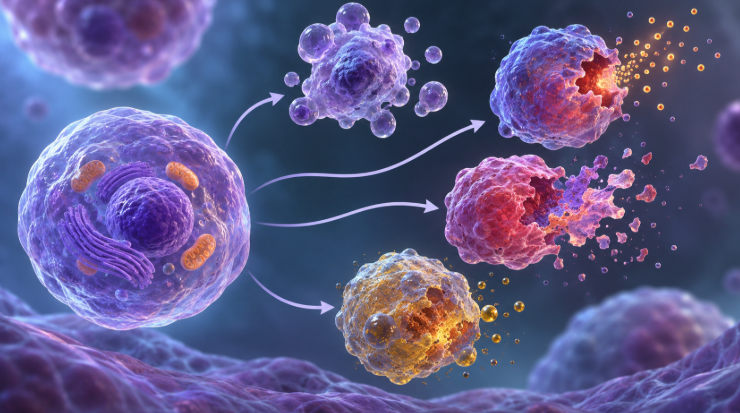
Not all of our cells die in the same way. Some are eliminated through highly organized processes; others die while releasing molecules that affect the immune system, and some are destroyed as a result of extensive damage. How a cell dies can influence inflammation, tissue function, and the progression of disease.
Why Do Our Cells Die?
Every day, billions of cells die in the human body. This isn’t necessarily a bad thing or a sign of disease. Cell death is a normal part of our development, tissue renewal, and the removal of cells that have accumulated mutations, sustained damage, or are simply no longer needed.
A well-known example occurs during embryonic development. As the fingers form, cells located between them are eliminated, helping the developing fingers separate. Similarly, throughout adulthood, many cells are continuously replaced as part of normal tissue renewal.
Different mechanisms of cell death can therefore have different effects on neighboring cells and the immune system. [1, 2]
What Is Cell Death?
Cell death occurs when a cell permanently loses its ability to function and can no longer remain alive.
Traditionally, scientists distinguished mainly between apoptosis, which was described as an organized process, and necrosis, which was associated with severe cellular damage.
Today, the classification is more complex. One important distinction is between regulated cell death (RCD), which occurs through specific molecular mechanisms, and accidental cell death (ACD), which results from extreme damage, such as the immediate physical destruction of the cell membrane. [1, 3]
The Different Ways Cells Die
1. Apoptosis: An Organized Form of Cell Death
Apoptosis is one of the best-studied forms of regulated cell death. During this process, a cell activates specific molecular pathways involving enzymes called caspases, which play a central role in the process.
The cell typically shrinks, its DNA becomes fragmented, and it may break apart into small membrane-bound structures called apoptotic bodies. These are then cleared by phagocytes or neighboring cells. When this process is carried out efficiently, the release of cellular contents is generally limited, helping prevent excessive inflammation.
Apoptosis plays an important role in normal development and the removal of damaged cells. However, some cancer cells develop the ability to evade apoptosis, allowing them to survive when they would otherwise be eliminated. [1, 3, 9]
2. Necrosis: When a Cell Loses Its Integrity
Necrosis describes a pattern of cell death characterized by changes such as cell swelling and loss of cell membrane integrity. As a result, cellular contents may be released into the surrounding tissue, where they can act as danger signals.
These features can occur following severe injury or an inadequate blood supply to a tissue.
However, not all cell death with necrotic features is accidental or unregulated. Some forms of regulated cell death can produce similar morphological changes. [1]
3. Necroptosis: Regulated Cell Death With Features of Necrosis
Necroptosis is a form of regulated cell death in which the proteins RIPK3 and MLKL play key roles. Activation of MLKL can disrupt the cell membrane, eventually causing it to rupture.
Necroptosis has been extensively studied in the context of infections and inflammatory conditions.
For example, certain viruses interfere with the mechanisms that trigger apoptosis. In some experimental models, necroptosis can provide an alternative way to eliminate infected cells.
However, this does not mean necroptosis is always protective. Depending on the circumstances, it can also contribute to tissue damage. [1, 3, 6]
4. Pyroptosis: Cell Death Linked to Inflammation
Pyroptosis is a form of regulated cell death closely associated with the innate immune system. One of its defining features is the formation of pores in the cell membrane by proteins belonging to the gasdermin family.
In many cases, pyroptosis involves the activation of an inflammasome and may be accompanied by the maturation and release of inflammatory cytokines, such as interleukin-1β (IL-1β) and interleukin-18 (IL-18).
Pyroptosis can contribute to the body’s defense against pathogens. However, excessive or inappropriate activation of this process can also lead to inflammatory tissue damage. [1, 4, 6]
Inflammation caused by cellular damage or infections may be reflected in laboratory markers, but these markers cannot identify which cell death mechanism has been activated.
For example, C-reactive protein (CRP) is widely used in clinical practice as a nonspecific marker of inflammation. However, CRP levels alone cannot determine the underlying cause of inflammation.
5. Ferroptosis: The Role of Iron and Lipids
Ferroptosis is a form of regulated cell death that depends on iron and is characterized by damaging lipid peroxidation in cellular membranes.
Cells have protective mechanisms that help limit this damage, including those involving an enzyme called GPX4. When lipid peroxidation overwhelms the cell’s protective defenses, cell death can occur.
Ferroptosis is being studied in cancer, neurodegenerative diseases, and tissue injury.
This does not mean that eating iron-rich foods causes ferroptosis. It is a complex intracellular process involving multiple molecular mechanisms. [5, 6]
6. Cuproptosis: A Cell Death Mechanism Linked to Copper
In 2022, researchers described a mechanism called cuproptosis in the scientific journal Science.
Under specific experimental conditions, the accumulation of copper inside cells causes interactions with lipoylated proteins involved in mitochondrial metabolism. These interactions are associated with protein stress and, ultimately, cell death.
Copper is an essential trace element. However, the discovery of this mechanism does not mean that consuming normal amounts of copper-containing foods is dangerous.
Researchers are investigating whether cuproptosis could have potential applications in cancer treatment. However, identifying a new cell death mechanism does not automatically mean it can be used as an effective therapy. So far, its therapeutic potential remains under investigation. [6, 7]
Are There Other Forms of Cell Death?
Modern research has identified several additional processes, although not all of them have the same level of experimental evidence supporting them.
For example, during the release of neutrophil extracellular traps (NETs), neutrophils can release networks of DNA and proteins that help defend the body against microorganisms. However, NET release does not always result in the death of the neutrophil.
Other recently proposed mechanisms include alkaliptosis, which is associated with an increase in intracellular pH, and NECSO (necrosis by sodium overload), a form of cell death that has been experimentally induced by overloading cells with sodium ions. [2, 6, 8]
Why Does It Matter How a Cell Dies?
Cell death affects more than just the dying cell. It can also influence the surrounding environment.
During certain forms of cell death, damaged or dying cells release molecules known as damage-associated molecular patterns (DAMPs). These molecules act as danger signals that can be recognized by immune cells and influence the inflammatory response.
In contrast, the efficient removal of apoptotic cells through a process called efferocytosis often helps keep inflammation under control.
When this clearance process does not function properly, the immune system may be exposed to increased amounts of cellular material.
Researchers are also investigating the role of these mechanisms in certain autoimmune diseases, in which the immune system mistakenly targets components of the body’s own tissues. [1, 11]
In other words, two cells can die through different mechanisms and have very different effects on the same tissue.
How Is Cell Death Related to Cancer?
Some cancer cells develop mechanisms that allow them to evade apoptosis or survive under conditions that would normally lead to cell death.
This is one reason why understanding the different mechanisms of cell death is particularly important in cancer research.
Scientists are investigating whether pathways such as ferroptosis and necroptosis could be targeted to eliminate cancer cells.
Another important area of research is immunogenic cell death (ICD), a form of cell death that, under the right conditions, can trigger an immune response against antigens from dying cells. [9]
This field of research is closely related to the broader study of anticancer immunity, although it is not the same as every form of cancer immunotherapy.
For example, an experimental therapeutic vaccine for pancreatic cancer aims to activate T cells against specific mutations in the KRAS protein. It is not a treatment specifically designed to trigger ferroptosis or necroptosis.
Can a Cell Recover After the Death Process Has Begun?
In 2012, researchers demonstrated that cells showing signs of advanced apoptosis could recover when the stimulus that triggered the process was removed.
They named this phenomenon anastasis, after the Greek word for “resurrection.”
However, this does not mean that a dead cell can come back to life.
Instead, it means that some cells may be able to recover even after apoptosis has begun, provided they have not yet reached the point at which cell death becomes irreversible.
This recovery is not always without consequences. In the original study, some of the surviving cells showed permanent changes in their genetic material. [3, 10]